


Meet the Global Fellows: Frontline Leaders at the Forefront of Solutions
The Collaborative on Global Children’s 2026 Global Fellows are practitioners, researchers, and advocates working on the front lines of challenges affecting children and families around the world. They bring deep expertise, lived experience, and innovative approaches to preventing and responding to child-family separation.
Around the world, children are growing up amid turmoil. Families and communities are enduring conflict, climate pressures, extreme poverty, migration, and eroding systems of support.
Just as children’s needs are escalating around the world, dramatic cuts to U.S. foreign assistance—especially reductions in child-centered programs historically supported by the United States Agency for International Development (USAID)—are adding new pressures to already stretched systems. A recent report by Mattito Watson, Catherine Kirk, and Severine Chevrel for the Georgetown University Collaborative on Global Children’s Issues, “Where Do We Go from Here to Support Children in Adversity? Recommendations from the Front Lines,” documents reports from local civil society organizations about widespread loss of technical staff, abrupt program closures, and harmful impacts on vital social safety nets, with deadly results for children and families Indeed, impact projections have estimated that these cuts could lead to an additional 4.5 million deaths in children younger than 5 years by 2030.
However, in the midst of this catastrophe, local leaders are continuing to carry the mantle forward with constrained resources, emphasizing the need for a reimagined system that shifts power and resources to local actors while supporting local, regional, and global networks for coordination and evidence exchange.
The precarity following USAID's abrupt closure reinforces the guiding principle that solutions for children must be shaped by the people closest to the challenges and strengthened through collaboration across disciplines, sectors, and borders. The Global Fellows Program at Georgetown University’s Collaborative on Global Children's Issues is designed to support local leaders driving this work around the world. Each year, the fellowship focuses on a pressing topic influencing children’s development, care, and protection. In 2026, global fellows are developing strengthened approaches for preventing and responding to child-family separations.
Grounded in the Front Lines
The global fellows are not merely observers of global challenges—they are responders, innovators, and leaders working directly with children and families every day. They include practitioners running community-based programs, policymakers shaping national strategies, and researchers translating evidence into action. Their work spans a wide range of intersecting issues, including child-family separations driven by child labor, incarceration, war, poverty, or migration. What unites them is lived, frontline experience and a shared thread of building creative solutions to prevent and respond to child-family separation, including state-sponsored separations.
Through the fellowship, these leaders come together to showcase on-the-ground innovations, enrich their networks, and share their wisdom with the wider field. They bring their learning to Georgetown University and an international audience by engaging in dialogues on campus and beyond, as well as presenting their innovative approaches through a published paper. They also receive leadership coaching and professional development support to build their skills for ongoing influence in the field.
Meet the Fellows
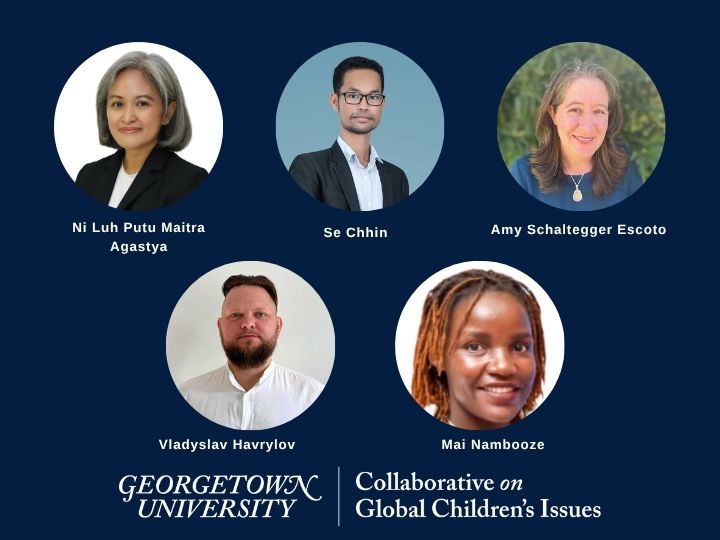
The 2026 fellows reflect bring deep expertise, diverse perspectives, and a shared commitment to improving outcomes for children and families. Though they work in different regions and sectors, they are united by a shared commitment to practical, grounded solutions for children and families and to learning from one another.
Ni Luh Putu Maitra Agastya leverages community-based approaches and locally led systems of support in Indonesia. With a vision to “co-produce intervention components with young people who engage in [child domestic] work while living apart from their families,” she uses participatory research methods to create policy solutions for child domestic labor, child marriages, child welfare, and climate change impacts on children.
Se Chhin is a connector bringing government, civil society, and development actors together to respond to family and system-level crises in Cambodia. As the deputy director of This Life Cambodia, he oversees out-of-home placement and reintegration programs for children who are separated from their families because of poverty and incarceration. Chhin describes what keeps him going: “I am motivated by the resilience of caregivers who continue to try despite immense challenges, and the gaps I see in the system that can be addressed through stronger leadership, collaboration, and evidence-informed practice.”
Amy Schaltegger Escoto leads cross-border child protection initiatives and family-centered reintegration programming for children affected by migration and separation. Her work as director of reintegration programs for Kids In Need of Defense (KIND) helps to translate case-level insights into advocacy priorities and structural reforms that bridge policy and practice in Central America, particularly Honduras. In her own words, she “works alongside deeply flawed child protection systems while resisting allowing those imperfections to define the outcomes for children.”
Vladyslav Havrylov brings insight into how systems adapt under pressure by working in a context shaped by war and displacement in Ukraine. He is an independent researcher with strong ties to academia and civil society. Since the full-scale invasion of Ukraine, Havrylov has focused his research on the forcible transfer, deportation, adoption, and reeducation of Ukrainian children by Russia. When asked about his work, Havrylov said he does it with the hope of “developing a global strategy to protect and rehabilitate children separated during military conflicts.” He added that he “hopes the successful rehabilitation of these children will help Ukrainian children stay in their home country and help build a future society despite it having been scarred by war and demographic challenges.”
Mai Nambooze empowers young people with lived experience of institutional care to influence policy reforms in Uganda. She is the founder and director of the Association of Care Leavers Uganda, a network of 1,000 people building locally led solutions for children and youth transitioning from care. Leveraging her lived experience, Nambooze turned her pain into power by mobilizing and advocating for young people. She continues to use her voice, cautioning that: “At the very moment when the Government of Uganda, the African Union, the United Nations, and global experts agree to end the institutionalization of children and greater investment in family- and community-based care, funding and visibility continue to flow toward models that keep children in institutions and turn their hardship into content.”
A Critical Moment for Children
Moments of change can also be moments of reimagining. The global fellows are helping to shape what comes next, advancing approaches that are locally grounded, collaborative, and responsive to evolving realities. Their work is helping drive a broader shift toward more sustainable solutions that center community knowledge, strengthen systems, and support children within families whenever possible. In places where formal systems are strained or absent, communities often become the first, and most consistent, line of support.
Looking Ahead
The challenges facing children today are complex, but so too is the global community working to address them. The global fellows remind us that across countries and contexts, there is no shortage of commitment, creativity, or insight.
What’s needed now is connection. By bringing together frontline experience and interdisciplinary collaboration, the Collaborative on Global Children's Issues is helping to build that connection and, in doing so, helping to shape a more resilient future for children and families worldwide.